
BASEMENT WATERPROOFING · REYNOLDSBURG, OH
Exterior Waterproofing & French Drains in Reynoldsburg, OH
Exterior waterproofing is the only approach that stops water before it reaches the foundation rather than managing it after it arrives. We excavate to the footing, apply membrane to the wall, bed perforated pipe in washed gravel, and backfill with material that drains instead of holding water. It is the most expensive option in the trade and the most permanent, and in expansive clay soils it is sometimes the only thing that genuinely works. It is also unnecessary more often than it gets quoted, and we will tell you when that is the case. Call (614) 739-0757 for a free on-site inspection.
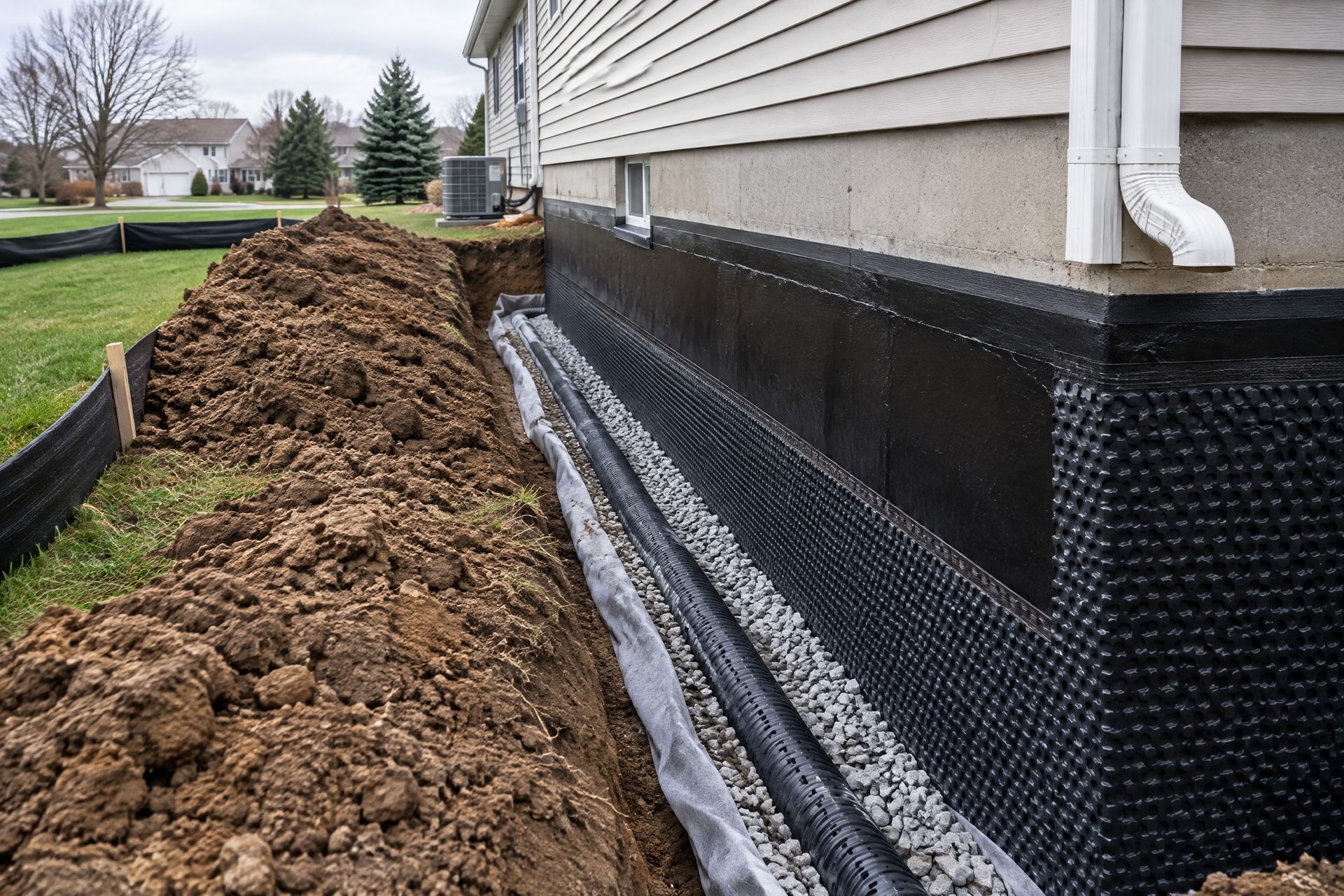
What exterior waterproofing involves
We excavate along the foundation all the way down to the footing — in Reynoldsburg that is typically seven to eight feet, and the depth is what drives the cost. With the wall exposed we clean it, repair any damaged block or poured concrete, and apply a waterproofing membrane rather than a damp-proof coating. The distinction matters: damp-proofing is a spray that resists moisture vapour, while a membrane is a continuous barrier designed to hold back liquid water under pressure. At the base we lay perforated drain pipe in washed gravel wrapped in filter fabric, sloped to daylight or to a sump, so water reaching the footing is carried away instead of pooling against it.
Backfill is the step that quietly decides whether the job works. Putting the original clay straight back against a new membrane recreates the problem — clay holds water against the wall and it swells when saturated, which is what pushes walls inward in the first place. We backfill the lower portion with free-draining granular material so water moves down to the drain tile rather than sideways into the wall, then finish with soil graded to fall away from the house. Downspouts get extended out past the excavation, and window wells get their own drainage tied into the system. Skipping any of that is how an expensive job ends up performing like a cheap one.
When exterior waterproofing is the right answer
These are the situations where interior drainage will not be enough on its own.
- Water running down the inside face of the wall during heavy rain, well above floor level
- A wall that keeps refilling with water after interior drainage has been installed
- Grading that cannot be corrected from the surface because the finished grade is above the interior floor
- A wall showing inward deflection, where relieving soil pressure is part of the structural fix
- You are finishing the basement and want the wall dry rather than managed
- Interior drainage has already been installed correctly and water is still entering above the floor
Get Your Free Quote
Why surface water reaches Reynoldsburg foundations
The ground here does not absorb rain quickly, and that single fact explains most exterior water problems in Reynoldsburg. Expansive clay and dense till have very low permeability, so during a heavy storm water does not soak in — it sheets across the surface looking for the lowest point. If the grade around your house has settled over decades, which it almost always has, that lowest point is the foundation wall. Once water is sitting in the backfill against the wall it stays there, because clay holds it. A foundation in that condition is under continuous hydrostatic pressure from outside.
Rapid development across the east Columbus area has also changed how stormwater moves. More pavement and rooftops mean water travels faster toward Blacklick Creek and local drainage systems, which are often undersized for modern storms. When a neighborhood storm sewer reaches capacity, the water backs up into yards and eventually against foundation walls. When a building goes years without trouble and then floods, the story is not always that the building changed. It is often that the surrounding watershed reached its limit and the soil simply cannot drain fast enough.
What affects the cost of exterior waterproofing in Reynoldsburg
Excavation depth and access dominate the price on this service. Full ranges are on our cost page.
- Depth to the footing — seven to eight feet is typical here, and every foot adds spoil to handle
- Linear footage of wall being excavated, and whether it is one elevation or a full perimeter
- Access for equipment — a narrow side yard or a fence line can force hand digging
- Obstructions over the dig line: decks, patios, driveways, AC units, mature trees and shrubs
- Utility locations, since gas, water and sewer laterals crossing the trench have to be worked around
- Restoration — replacing landscaping, hardscape or driveway that had to come out
Interior or exterior — which one you actually need
The honest framing is that these are not competing products, they are answers to different questions. Interior drainage manages water that is already arriving from below, which in Reynoldsburg usually means a perched water table sitting above the basement floor. You cannot lower a regional water table by digging outside, so if water is coming up through the slab or in at the wall-floor joint, exterior waterproofing does not address the mechanism — and it costs several times more. Anyone who quotes excavation for a floor-level water problem without explaining why is selling the bigger job rather than the right one.
Exterior is the correct answer when water is arriving from outside above floor level: running down the wall face during rain, entering through cracks partway up the wall, or continuing after grading and downspouts have already been corrected. Where Reynoldsburg gets genuinely complicated is a wall in clay taking water from both directions at once. Sometimes the right recommendation really is both, and sometimes it is exterior on the one elevation that faces the slope with interior drainage handling the rest. That is a judgement made standing at the wall, not on a phone call.
Our step-by-step process
- STEP 1
On-site diagnosis confirming water is entering from outside above floor level, not rising from below
- STEP 2
Written fixed-price quote covering excavation, membrane, drainage, backfill and restoration
- STEP 3
Utility locates called and permit requirements should be confirmed before work begins
- STEP 4
Excavation to the footing, with spoil staged where it will not wash back into the trench
- STEP 5
Wall cleaned, foundation repaired, then waterproofing membrane applied as a continuous barrier
- STEP 6
Perforated drain pipe bedded in washed gravel with filter fabric, sloped to daylight or a sump. Sump discharge routes should be verified with the local authority.
- STEP 7
Granular backfill in the lower trench, soil above it graded to fall away, downspouts extended past the dig
- STEP 8
Inspection, landscaping or hardscape restored, and a walkthrough of what was installed
Timeline and what to expect
Three to five days for one or two elevations, longer for a full perimeter. This is the most disruptive service we offer and it is worth knowing that before you commit — there will be an open trench beside your house, heavy equipment on the property, and a section of yard that looks destroyed until restoration. It is also the one job that genuinely depends on weather. An open trench in dense clay and a heavy rain do not mix, because the trench fills, the walls slump, and the membrane cannot be applied to a wet surface. We watch the forecast and we will delay a start rather than open a hole ahead of a storm. Membrane needs a dry wall to bond, so a wet week pushes the schedule and there is no way around that.
GOOD TO KNOW
FAQs
Is exterior waterproofing worth the extra cost?
When it is the right diagnosis, yes, because it addresses the cause rather than the symptom and it does not depend on a pump continuing to work. When it is the wrong diagnosis it is expensive and it will not fix the problem, which is the part that gets left out of most sales conversations. If your water is arriving from below, excavating outside cannot help you no matter how much it costs. Get the diagnosis right first and the value question answers itself.
We will disturb it, and we would rather be honest about that than surprise you. Spoil goes on plywood or sheeting rather than straight onto grass, we keep the working corridor as narrow as safety allows, and we reinstate the grade and reseed at the end. But a trench along one wall of your house is visible for a season afterward. Mature planting in the way generally cannot be saved, and we will tell you which specific plants are at risk before we start.
Will you have to dig up my landscaping and driveway?
Whatever sits over the excavation line has to come out. Shrubs can often be dug and held for replanting if they are healthy and the timing is reasonable. Mature trees close to the foundation are a genuine problem, because cutting major roots can destabilise them, and occasionally that rules out exterior work on one elevation entirely. Concrete patios, decks and driveways over the trench line have to be cut and replaced, and we quote that restoration up front rather than discovering it mid-job.
What is the difference between waterproofing and damp-proofing?
A Damp-proofing is a coating that resists moisture vapour moving through masonry. Waterproofing is a membrane that holds back liquid water under pressure. Most homes built with any exterior treatment at all got damp-proofing, which was standard practice and is not adequate for saturated clay against a foundation wall. If a quote says damp-proof rather than waterproof, that is a meaningful difference and worth asking about, because the price difference reflects a real difference in what the product does.yard French drain intercepts surface and shallow water somewhere out in the lawn, away from the house. What we install against the foundation is a footing drain — it sits at the base of the wall, below the level of your basement floor, and its job is to relieve water at the point where it would otherwise push against the structure. Some properties need both. If your problem is water sheeting across the yard toward the house, a yard drain may be all you need, and it is cheaper.
Can this be done in winter?
Sometimes, but Ohio winters make it difficult. Frozen ground is hard to excavate cleanly, membrane adhesives have minimum application temperatures, and a trench open through a freeze-thaw cycle is unstable. Late spring through early autumn is the practical window here. If you have an active water problem in February, interior drainage is usually the better move — it is not weather-dependent, and it can be done while you wait for conditions to allow exterior work if that turns out to be needed.
Do you need to excavate the whole perimeter?
Usually not, and this is where an honest inspection saves real money. Water almost always enters on the elevation facing the slope or the elevation with the drainage defect, and treating that one wall properly often solves the problem. We inspect all four sides, check the grade, and quote only what needs doing. A full perimeter is sometimes genuinely necessary, but it should be a conclusion rather than a default.
Find out whether you need to dig at all
Free on-site inspection and a written fixed price. Most homeowners who call about exterior waterproofing need something smaller, and we would rather quote the right job than the biggest one. Call us to schedule a visit in Reynoldsburg or the east Columbus area.